
1. Project Overview
This client project evaluates the local search and AI discovery footprint of a boutique strength coaching studio in an urban neighborhood. Local fitness providers depend heavily on proximity signals, Google Maps 3-Pack placement, and neighborhood search queries (e.g., "personal trainer near me" or "strength gym [neighborhood]").
With prospective members increasingly asking conversational engines (Perplexity, ChatGPT Search, and Google AI Overviews) questions like "What is the best beginner-friendly strength gym in [District]?", this project establishes a practical optimization blueprint spanning both traditional local map packs and generative AI discovery.
NAP stands for Name, Address, and Phone number. Search engines cross-validate these details across web directories. Discrepancies (e.g., "Olympia Studio" vs. "Olympia Fitness LLC") fragment citation authority, diluting search engine trust and allowing competitors to outrank the business.
2. Search Performance & Evidence
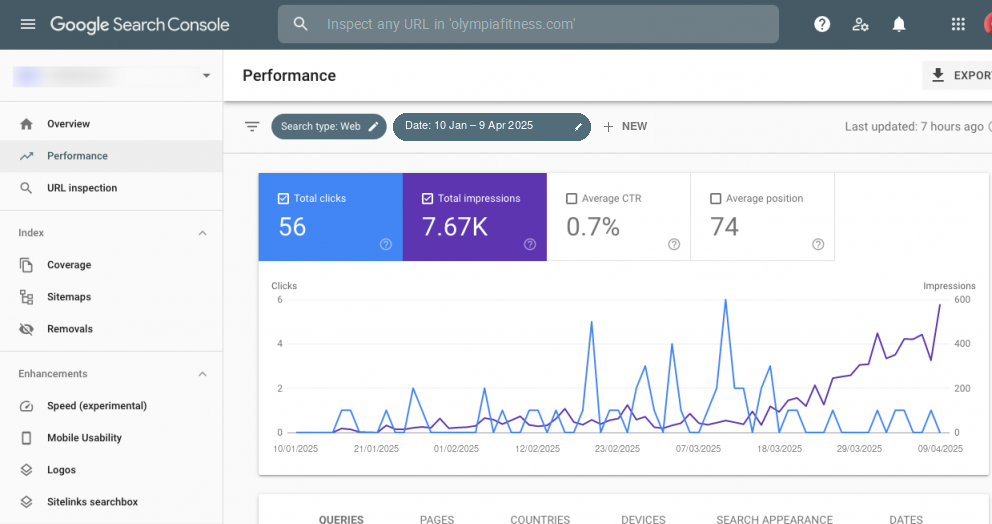
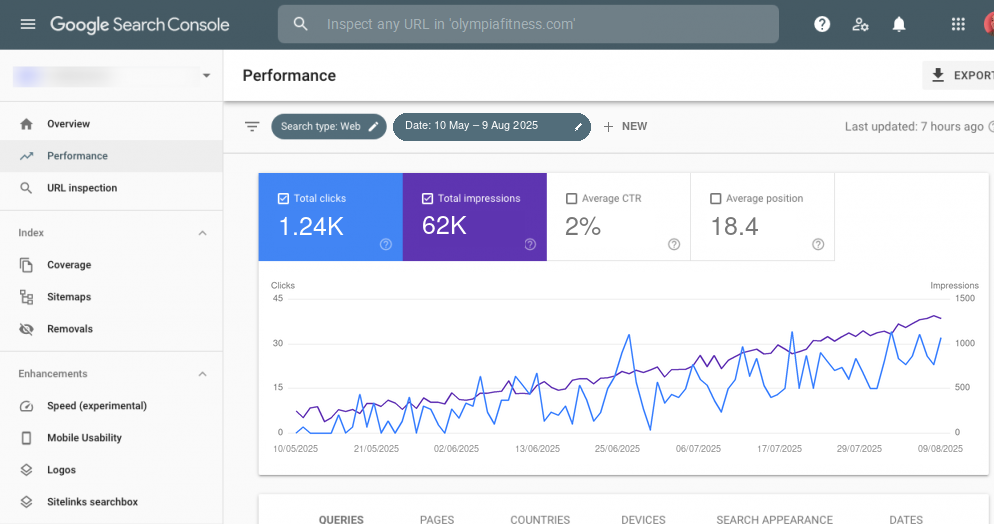
To evaluate search visibility across Google Search, performance was tracked across two reporting windows in Google Search Console: 10 January–9 April 2025 (baseline) and 10 May–9 August 2025 (follow-up).
| Metric | Before: 10 Jan–9 Apr 2025 | After: 10 May–9 Aug 2025 | Observed Change |
|---|---|---|---|
| Total clicks | 56 | 1.24K | ~2,114% increase |
| Total impressions | 7.67K | 62K | ~708% increase |
| Average CTR | 0.7% | 2% | +1.3 percentage points |
| Average position | 74 | 18.4 | Improved from 74 to 18.4 |
Reporting Context: Percentage calculations are approximate due to abbreviated totals (1.24K, 62K). The reporting dates represent two separate windows with a one-month gap, not consecutive periods. In Google Search Console, "Total clicks" refers specifically to Web search clicks directing users to the site (not total visitors, phone calls, or memberships), and "Average position" reflects the aggregate average ranking across all queries generating impressions. These metrics are presented alongside the methodology without claiming the screenshots prove which individual action caused the shift.
3. Observed Audit Findings
An initial diagnostic audit identified five primary friction points restricting local discovery:
- NAP Inconsistencies Across Directories: Naming variations ("Olympia Studio" vs. "Olympia Fitness LLC") and inconsistent phone formats across Yelp, Bing Places, and YellowPages fragmented citation signals.
- Incomplete Google Business Profile: Lacked secondary categories (Personal Trainer, Gym), had an unpopulated service catalog without pricing or descriptions, and zero Google Q&A entries.
- Thin Service Landing Pages: Program pages (1-on-1 Coaching, Small Group Training) lacked neighborhood context, proof points, and targeted copy for non-brand searchers.
- Missing Structured Data: Absence of JSON-LD schema forced search engines to rely on unstructured text heuristics rather than verified entity coordinates and operating hours.
- Zero AI Citability: Program details were buried in marketing prose, leaving conversational AI engines unable to extract factual summaries or cite the studio.
4. Project Approach
To systematically resolve the audit findings, I formulated a four-pillar optimization strategy covering local authority, search intent, technical schema, and conversational AI extraction:
A. Google Business Profile & Directory Alignment
For a detailed guide on category weighting and review signals, read our guide on Google Business Profile optimization.
- Issue Identified: Incomplete GBP missing secondary categories and service catalog items, combined with conflicting NAP citations across web directories.
- Specific Action Proposed: Set Fitness Center as primary category, adding Personal Trainer and Gym as secondary categories. Populated the service catalog with transparent pricing and class durations. Initiated directory cleanup to unify NAP details.
- Tool Used: Google Business Profile manager and manual local directory audit.
- Purpose: Strengthen algorithmic relevance for local proximity queries and reinforce citation consistency.
- Recorded Outcome: A complete profile configuration blueprint and directory discrepancy register were documented; local map pack rankings remain an ongoing qualitative objective.
B. Search Intent & Keyword Mapping
Using Ahrefs Keywords Explorer, local query patterns were researched and mapped directly into targeted site destinations:
| Search Category | Query Examples | User Goal | Optimization Focus |
|---|---|---|---|
| Proximity / Map | gym near me, personal trainer downtown | Find closest physical location | Google Business Profile & local citations |
| Service / Program | small group strength training classes | Compare specific program styles | Dedicated service landing page |
| AI / Conversational | best beginner-friendly gym in [District] | Get a curated summary or recommendation | Factual FAQ answers & review signals |
C. ExerciseGym Structured Data Architecture
Adding structured JSON-LD code provides search engines and AI engines with unambiguous entity facts:
- Entity Type:
ExerciseGym(sub-type ofLocalBusiness) for hyper-specific fitness relevance. - Geo-Coordinates: Explicit latitude and longitude (
34.0522, -118.2437) for proximity ranking. - Verified NAP: Official business name, street address, and phone number linked programmatically.
- Operating Hours & Pricing: Machine-readable weekly schedules and price tiers (
$$).
- Issue Identified: Absence of structured data on the gym website, hindering entity recognition by search engines.
- Specific Action Proposed: Authored custom
ExerciseGymJSON-LD markup embedding geographical coordinates, address details, weekly schedules, and service links. - Tool Used: Schema.org Validator and Google Rich Results Test.
- Purpose: Deliver clean, machine-readable facts directly to Google's Knowledge Graph and AI engine retrieval parsers.
- Recorded Outcome: Structured data code validated with zero syntax errors or missing required properties in the Schema.org Validator.
D. Service Content & Conversational FAQ Structuring
To make it easy for conversational AI engines (Perplexity, ChatGPT Search, Google AI Overviews) to find and cite the studio, direct Q&A modules were designed:
- "What equipment does Olympia Fitness Studio have?" → Direct list of barbells, squat racks, kettlebells, and cardio equipment.
- "Are classes suitable for complete beginners?" → Direct answer detailing the introductory 4-week foundational onboarding program.
- Issue Identified: Thin service pages and unformatted marketing copy failed to satisfy conversational queries or provide extractable answers for AI tools.
- Specific Action Proposed: Formatted program descriptions with localized context and added structured Q&A blocks addressing beginner onboarding and equipment inventory.
- Tool Used: Ahrefs (search intent analysis) and Perplexity (prompt retrieval testing).
- Purpose: Improve organic service-page relevance and provide concise passages optimized for LLM answer extraction and citation.
- Recorded Outcome: Program content templates and FAQ blocks authored; active AI citation presence remains a qualitative monitoring goal.
5. Tools Used in This Study
- Google Search Console: Tracked and compared Web search visibility across the baseline (10 Jan–9 Apr 2025) and follow-up (10 May–9 Aug 2025) reporting windows, measuring total clicks, impressions, CTR, and average position. (Does not track Google Maps local pack or AI citations).
- Google Business Profile: Structured core business details, primary and secondary category assignments (Fitness Center, Personal Trainer, Gym), service catalog listings, and review generation workflows.
- Ahrefs (Keywords Explorer): Conducted local search intent research, analyzing query variations for neighborhood fitness, personal training, and gym searches to map user intent to specific site pages.
- Schema.org Validator: Validated the custom
ExerciseGymJSON-LD structured data graph, checking syntax, property compliance, and geo-coordinate formatting against official Schema.org standards. - Perplexity & AI Search Testing: Tested natural-language queries against site copy to evaluate how conversational AI answer engines extract, synthesize, and cite local business details.
6. Key Learnings & Next Steps
Core takeaways and continuing evaluation criteria established during this project:
- Local SEO is Foundational for AI Search: Conversational AI assistants rely on existing structured data, Google Maps listings, and authoritative directory citations to answer local questions. If local SEO foundations are weak, AI engines cannot reliably cite the business.
- Review Text Drives Relevance: Customer reviews that naturally mention specific programs and coach names provide valuable contextual keywords for local search relevance.
- Continuing Qualitative Benchmarks: While Google Search Console verifies aggregate Web search growth (clicks rising from 56 to 1.24K), three qualitative benchmarks require ongoing monitoring:
- Google Maps 3-Pack Placement: Achieving consistent local 3-pack rankings for proximity-based gym and coaching queries.
- 100% Citation Consistency: Maintaining uniform Name, Address, and Phone data across all primary local business directories.
- AI Search Discovery & Retrieval: Securing factual, accurate citations when conversational engines answer neighborhood fitness inquiries.